
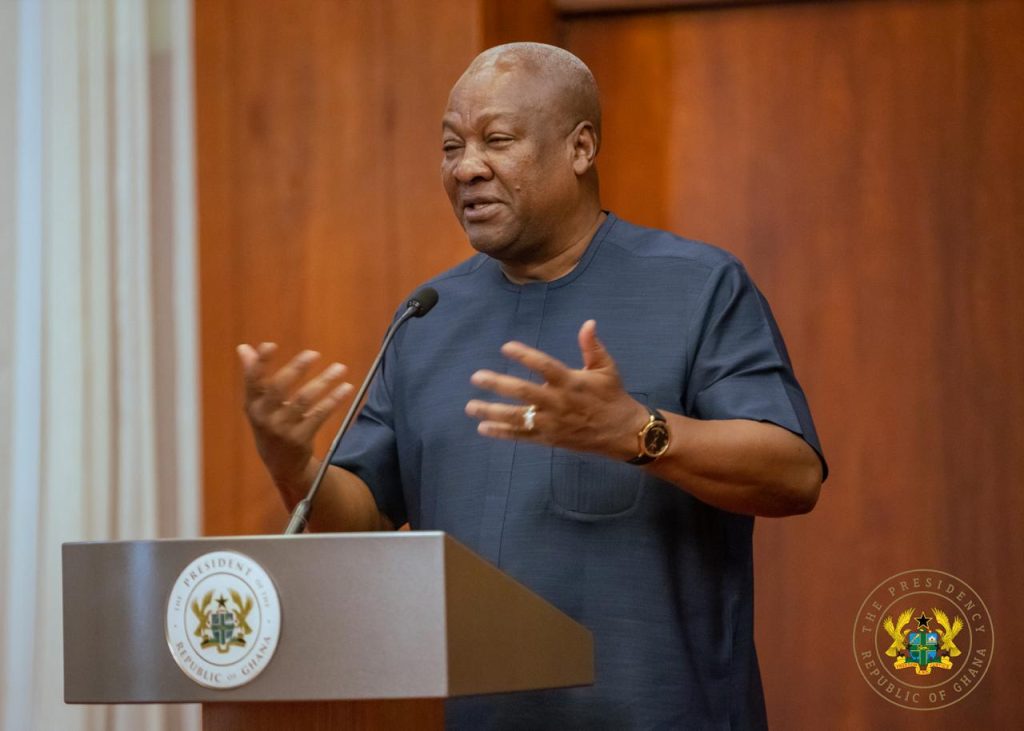
President John Dramani Mahama has launched the Ghana CEO-Government Compact 2026, a new framework meant to turn years of talk between government and the private sector into measurable action. He unveiled it on May 29, 2026, at the 10th Ghana CEO Summit, held at the Kempinski Hotel Gold Coast City in Accra.
The Compact sets out mutual commitments between the state and the business community, with defined targets rather than the loosely worded pledges that have typically followed past CEO summits. President Mahama was also named Chief Patron of the Ghana CEO Summit during the event.
What the Compact commits government to
Under the Compact, government has committed to treating regulatory reform as a national priority, aimed at cutting the bureaucratic delays and conflicting instructions from different agencies that have long frustrated investors and business owners.
President Mahama pledged clearer, more transparent procedures across government bodies and less duplication in the approvals businesses have to chase.
Other commitments outlined include:
- Reducing power costs for industrial users
- Improving logistics and transport infrastructure
- Developing industrial and agro-processing parks
- Offering incentives for business expansion
- Drafting a national e-commerce policy targeted at SMEs, women-led businesses and young entrepreneurs
He also referenced the government’s 24-hour economy agenda, describing it not as a push for longer working hours but as a strategy to build up infrastructure, energy supply, logistics and digital systems so production capacity can expand around the clock.
What business is expected to deliver
The Compact is not one-directional. In return, the private sector is being asked to raise product standards and certification, improve packaging and logistics, and sharpen market intelligence so Ghanaian goods can compete beyond the domestic market.
Businesses are also expected to strengthen agribusiness value chains that link farmers, processors and exporters, particularly in cocoa, cashew, shea, oil palm, rice, poultry, textiles and pharmaceuticals, sectors the government has flagged for priority industrial growth.
President Mahama called on CEOs at the summit to increase investment, improve productivity and create decent jobs, framing the exchange as one where government reform is matched by business delivery.
“This compact is intended to serve as a high-level partnership framework between government and the business community, promoting accountability, innovation, competitiveness,” he said.
Why the framework was needed
The Compact is built around an argument the President made directly to the summit: that government and business must stop treating their relationship as ceremonial.
“The relationship between government and the private sector must become a working partnership grounded in trust, policy consistency, mutual accountability and a shared national purpose,” he told the gathering.
He linked the Compact to Ghana’s recent macroeconomic stabilisation, arguing that steadying the economy was only the first step. “Our stability must end up paying for production. Production must create jobs, jobs must raise incomes,” he said, adding that the current stability “is not a fluke” and would be sustained.
He also pointed businesses toward opportunities in the African Continental Free Trade Area, urging firms to use Ghana’s hosting of the AfCFTA Secretariat to expand into regional markets.
Reactions from the business community
Business leaders at the summit welcomed the shift toward a results-based framework. Moses Baiden Jnr, Chief Executive of Margins Group, tied the Compact’s success to how prepared companies are to act on it, saying, “If we are serious about accelerating Ghana’s economic transformation, then leadership must mean preparedness.”
Edward Ekow Obeng-Kenzo, Chief Executive of the Volta River Authority, described the summit as “a critical platform for advancing leadership, technology, industrialisation, and corporate governance reforms,” and pledged VRA’s continued commitment to reliable power supply, a direct link to the energy-cost concerns the Compact is meant to address.
Ghana CEO Summit founder and convenor Ernest De-Graft Egyir, who was tasked by President Mahama with developing the Compact framework, has positioned the summit as a “national executive policy dialogue institution” now entering its second decade.
Next steps
President Mahama was direct about wanting the Compact to outlast the summit stage. “Let today’s summit not end as another successful event without measurable follow-ups. The next steps must be structured,” he said, adding that its success would be judged “not by its launch, but by its impact on real economic outcomes such as expanded production, stronger exports, and improved livelihoods.”
Elizabeth Ofosu-Agyare, Minister for Trade, Agribusiness and Industry, has been tasked with presenting the finalised Compact framework to the Attorney-General for legal review before it moves into implementation. Further engagement between the President and business leaders is expected once that review is complete.
For now, the Compact stands as a stated intention rather than a signed, binding document. Its real test will come in whether the promised reforms on regulation, energy costs and infrastructure actually reach businesses on the ground, and whether companies match that with the investment and job creation government is asking for.