
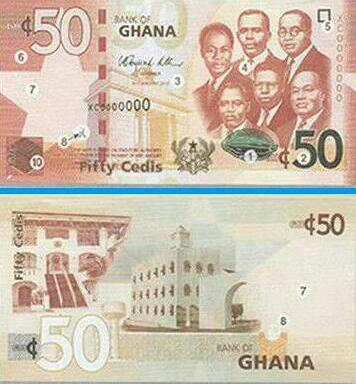
The cedi was trading at roughly GH¢12.45 to the US dollar on the retail forex market and around GH¢11.75 on the Bank of Ghana‘s interbank market in the second week of August 2026, according to daily rate reports from Modern Ghana. The two-figure split, one price for everyday forex bureau transactions and a lower one for interbank trading, has become a familiar feature of the cedi’s story this year, a year that has already delivered double-digit losses against the dollar.
Forex bureaus vs the interbank rate
Ghanaians buying dollars over the counter are paying noticeably more than the rate banks trade at among themselves. On August 12, forex bureaus quoted GH¢12.45 while the Bank of Ghana’s interbank rate stood at GH¢11.75, per Modern Ghana’s daily currency tracker. A day earlier, on August 11, the bureau rate was also GH¢12.45 against an interbank rate of GH¢11.78.
That gap of roughly 70 pesewas, close to a 6 percent premium, has held fairly steady through early August. Earlier in the month the numbers were a touch friendlier to the cedi: GH¢12.30 at bureaus against GH¢11.68 on the interbank market on August 3, easing to GH¢12.30/GH¢11.71 on August 4 and GH¢12.35/GH¢11.73 on August 5, before drifting to the mid-GH¢12.40s by mid-month.
A rough July for the local currency
August’s numbers follow a difficult July. The cedi depreciated by 3.1 percent against the dollar during the month, pushing its year-to-date loss on the interbank market to about 10.4 percent, according to analysis reported by The Ghana Report, which cited IC Insights.
The slide built up steadily across the first half of the year too. Citi Newsroom reported that the interbank rate moved from about GH¢10.95 at the start of 2026 to roughly GH¢11.55 by July, a first-half loss against the dollar of around 9.5 percent, with the retail market already above GH¢12.25 by then.
What is driving the depreciation
Analysts point to a rebound in dollar demand as one of the clearest triggers. Foreign exchange demand picked up again in July after easing in June, driven in part by energy and other import bills, according to the IC Insights analysis carried by The Ghana Report. Energy sector players in particular need steady dollar supplies to pay for crude oil imports, refined petroleum products and settlements with independent power producers, a recurring pressure point cited across multiple reports this year.
Reserves have also taken a hit. Gross international reserves fell by about US$1.2 billion to roughly US$12.9 billion, partly because of a US$700 million Eurobond payment and a US$811 million market intervention in June, according to The Ghana Report.
How the Bank of Ghana is responding
The central bank has not been sitting on the sidelines. It sold more than US$8.2 billion through its FX Intermediation and FX Intervention programmes between January and July 2026, and injected about US$2.01 billion in June alone across its various support windows. For August, the Bank of Ghana has signalled plans to sell up to US$1 billion into the market through its Forex Intermediation Programme, with auctions held every two weeks and open to licensed commercial banks.
Bank of Ghana officials have described the recent pressure as reflecting temporary market movements rather than a deeper structural problem, and have said the institution remains capable of supporting the market when necessary.
What it means for consumers and businesses
For the ordinary Ghanaian changing money at a forex bureau, the wider gap between the bureau rate and the interbank rate means dollars simply cost more out of pocket than the headline rate suggests. Importers who rely on bank channels get closer to the interbank price, but still face a currency that has lost roughly a tenth of its value against the dollar since January.
That has knock-on effects for the cost of imported fuel, raw materials, machinery and finished goods, pressures that tend to filter into prices on the local market over time. Ghanaians receiving remittances through services such as LemFi and Taptap Send have, notably, been getting rates closer to the interbank figure rather than the pricier bureau rate, which works in their favour when converting dollars sent from abroad.
Outlook
IC Insights expects the Bank of Ghana to keep up its regular forex intermediation support through August, but with reserves under strain, the firm sees slight downside risk for the cedi this month. The steadier daily movements seen between August 10 and 12, when the bureau rate held at GH¢12.45 and the interbank rate hovered narrowly between GH¢11.75 and GH¢11.78, suggest the currency has found a temporary footing rather than a decisive turnaround.
Whether that holds will depend largely on how import demand behaves through the rest of the third quarter, and on how much firepower the central bank is willing and able to keep deploying to defend the cedi.