

It is one of the most awkward conversations in any new relationship. “Should we use a condom?” Many Ghanaians skip it completely, and the data suggests that more of us are skipping it than before. Condom use in Ghana has been falling for about two decades, and the Ghana AIDS Commission says this threatens the country’s plan to end AIDS as a public health threat by 2030.
This is not a story about judging anybody’s private life. It is about numbers that affect real families, and about a conversation that could protect you.
What the data on condom use in Ghana shows
At the 15th National HIV and AIDS Partnership Forum in Accra, the Commission’s Director of Research, Monitoring and Evaluation, Isaiah Doe Kwao, presented figures from the Ghana Demographic and Health Surveys. They track condom use during the last higher-risk sexual encounter among adults aged 15 to 49.
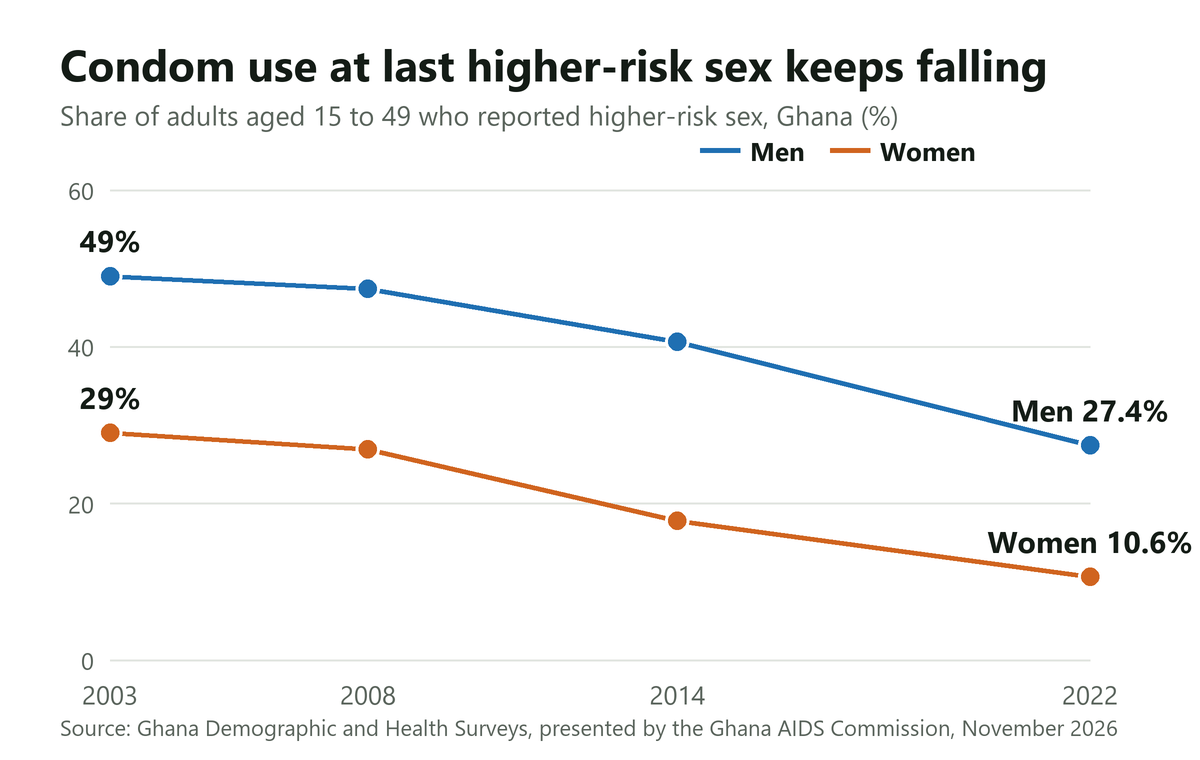
- Men: 49 percent in 2003, 47.4 percent in 2008, 40.6 percent in 2014, 27.4 percent in 2022
- Women: 29 percent in 2003, 26.9 percent in 2008, 17.8 percent in 2014, 10.6 percent in 2022
Put simply, by 2022 fewer than three in ten men and about one in ten women used a condom in that situation.
At the same time, more adults reported higher-risk sex. Among men, it rose from 10.2 percent in 2003 to 15.1 percent in 2022. Among women, it rose from 1.1 percent to 2.2 percent.
In these surveys, “higher-risk” generally refers to sex with someone who is neither your spouse nor living with you. So it describes a situation and not a person’s character.
An important note on the dates
The latest condom figures are from 2022, so they do not tell us what happened in the past four years. There are also limits to what surveys can capture, because people do not always report their sexual behaviour accurately. What makes the trend notable is its consistency across four surveys.
The newer HIV numbers
More recent figures reported by Rainbow Radio from the same forum give a fuller picture for 2025:
- 13,951 new HIV infections nationally
- 8,900 of those, or 63.8 percent, among women
- slightly over 330,000 people living with HIV by the end of the year
- 3,141 new infections in Greater Accra, the highest figure reported, with more than 77,000 people living with HIV in the region
Accra residents should pay attention here. The Commission linked the high urban figures to dense populations. “What are we doing to reduce these numbers?” Mr Kwao asked. That is a fair question for all of us, and not only for officials.
Why are women carrying more of the burden?
The figures reported do not fully explain this, and we won’t guess at a single cause. But the gap in the condom data is hard to ignore. Women reported using condoms far less often in these situations than men did. Advocates in many countries have long pointed out that negotiating condom use is not always easy for women, particularly when there is pressure in the relationship or a dependence on a partner’s money.
This is why the conversation matters. If it feels impossible to raise protection with your partner, that tells you something important about the relationship too.
Stigma is part of the problem
The Commission also raised concern about persistent discrimination against people living with HIV. When people fear being treated badly, they may be less willing to test or to stay on treatment. Mr Kwao warned that negative attitudes could undermine the gains Ghana has made.
So this is not only a health ministry matter. It also shows up in how we talk about people at home, at church, in the office and in our WhatsApp groups.
Practical steps for you and your partner
This is general information and not personal medical advice. For personal guidance, speak to a health worker.
- Have the talk early. It’s much easier before things get heated. Try: “I care about both of us, so let’s be safe.”
- Know your status. Testing is the only way to know. Consider going together as a couple and ask at a health facility near you.
- Use condoms consistently and correctly. The World Health Organization lists them among the effective ways to prevent HIV.
- Don’t judge by appearance. You cannot tell whether someone has HIV by looking at them.
- Treatment works. If you test positive, seek care early. The WHO says HIV is now a manageable chronic condition for people with access to treatment.
For more on health issues making news this week, read what Ghana’s new Ebola screening rules mean for travellers.
Time to talk about it
Falling condom use is not just a line on a chart. It is the sum of many private decisions, made by people who may not feel able to talk openly about them. Ending AIDS by 2030 will take more than a government programme. It will also take many uncomfortable conversations in our homes.
Why do you think fewer people are using condoms? Is it trust, cost, pressure, shyness or something else? Please share your thoughts respectfully in the comments, and share this article with someone who may need to read it.
Featured image: A red ribbon, the international symbol of HIV awareness. File image. Photo: NIAID, CC BY 2.0, via Wikimedia Commons (cropped).