
Think about how many places hold a copy of your Ghana Card. The bank. The school. That office where a security man asked for “a photocopy, please” and dropped it into a pile on his desk. Ghana Card photocopying used to be so normal that nobody questioned it. Since Tuesday, November 3, it can land an institution in court.
The National Identification Authority (NIA) has started enforcing the National Identity Register (Amendment) Regulations, 2026, known as L.I. 2523, after a three-month grace period ended on November 2. Here is what that means for ordinary card holders and for the people running businesses.
What the Ghana Card photocopying rule says
According to the NIA’s briefing, institutions may no longer photocopy, scan or keep copies of the Ghana Card for identity verification. Looking at the photo and comparing it with the face in front of them is not good enough either.
Instead, identity has to be confirmed through approved biometric methods. The NIA says the aim is to reduce impersonation and fraud and to protect personal information.
The good news for card holders is simple: you do not need a new card, and you do not need to capture your biometrics again. The system uses what was collected when you registered.
How verification should work now
There are two main routes the NIA has described.
- Match-on-card: telecoms companies can still ask for your physical card, so your fingerprint can be matched against the data on its chip. This is allowed, and it should not be confused with photocopying.
- Direct platform connection: banks and other connected institutions can verify customers using their Ghana Card numbers through the NIA’s system.
So being asked to present your card is not automatically illegal. What is banned is relying on the look of the card, or keeping a copy of it, for verification.
How much are the fines?
The penalties are set in penalty units, and that is why you may have seen different numbers.
- Institutions: 500 to 2,000 penalty units
- In cedis: GH¢6,000 to GH¢24,000, based on Graphic Online’s calculation at GH¢12 per penalty unit
- Individuals: GH¢600 to GH¢6,000, also according to Graphic
The NIA cannot impose these fines itself. It says it would take offenders to court, where the punishment would be decided. It can, however, act on its own by removing an institution from its verification platform and restricting future access.
Small businesses, pay attention
This may be the part of the story that has received the least attention. Many small firms have long depended on a photocopy because it was cheap and easy. The NIA has now shut some of the workarounds.
- Institutions must deal with the NIA directly. It says it uses no agents, resellers or intermediaries.
- Connected institutions must not sublet their access to other businesses. The NIA specifically mentioned small and medium-sized enterprises here and says it has identified such arrangements.
- To get access, an institution must be legally registered in Ghana, obtain Data Protection Commission certification and complete technical integration before signing an agreement.
That raises a fair question. How does a small hostel, loan shop or school office comply if it cannot easily connect? The reports we reviewed do not state what onboarding costs or how long it takes. If you run such a business, get the answer from the NIA itself, and be careful with anybody selling you “NIA access” on the side.
Why the authorities pushed this through
Photocopies are risky because they can travel. A copy of your card sitting in a drawer can be seen, reused or sold without you ever knowing. The Bank of Ghana said as far back as March 2025 that it had never approved photocopying and warned that the practice exposed customers to fraud, Graphic reports.
Identity theft is not an abstract worry either. The Cyber Security Authority has warned jobseekers not to share identification documents with unverified recruiters. We go through more of those warning signs in our guide to making money online in Ghana without getting scammed.
Biometrics are spreading elsewhere as well. Parliament has just brought in a biometric attendance system for MPs, although that system is a separate matter from these rules.
What to do if someone asks for a copy
- Ask how they verify identity. A polite question often clears things up: “Are you connected to the NIA platform?”
- Know the difference. Showing your card for a fingerprint match is allowed. Handing over a copy to be kept is the practice the law targets.
- Report it. The NIA’s Biometric Verification Task Force hotline is 030-2999-309.
- Do not fight at the counter. If the service is urgent, get the institution’s name and report it afterwards.
This is general information and not legal advice. If a dispute affects your business or a major transaction, speak to a lawyer or contact the NIA.
The real test starts now
A law is only as strong as what happens at the counter on a busy Monday morning. The NIA says its task force is inspecting public and private institutions. Whether banks, schools, landlords and small offices actually change their habits is what Ghanaians will be watching.
Has anyone asked you for a photocopy of your Ghana Card this week? Where was it, and what did you say? Share your experience in the comments.
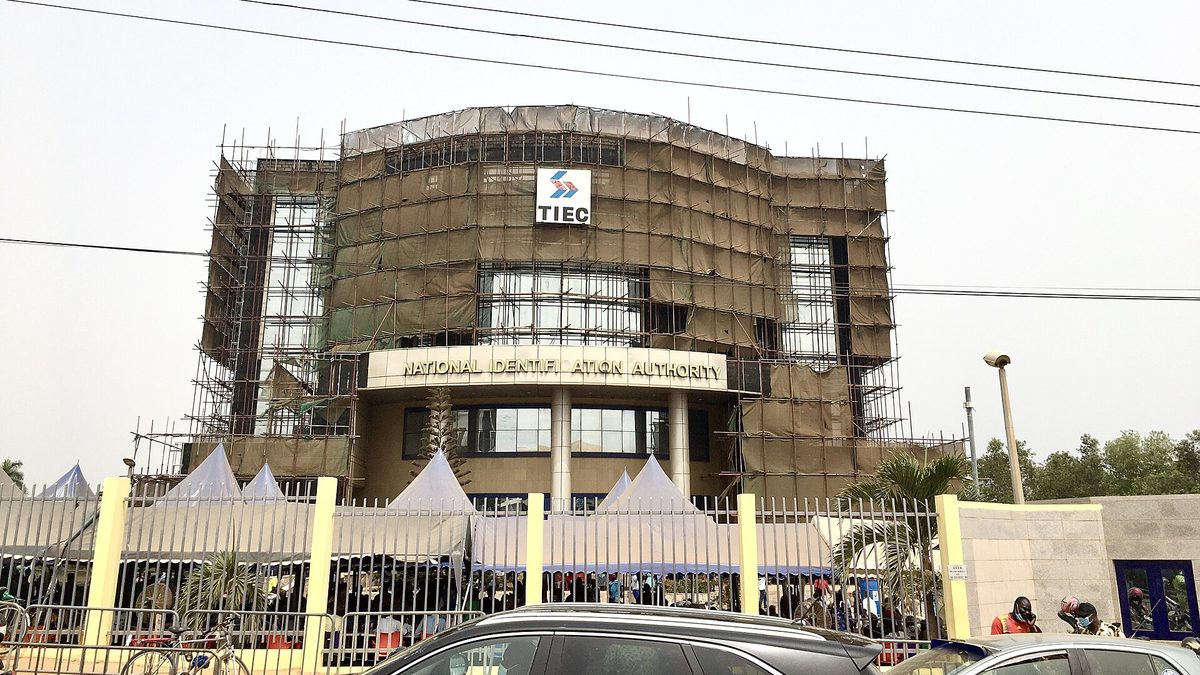
Featured image: The National Identification Authority building, photographed in 2022. Photo: Amuzujoe, CC BY-SA 4.0, via Wikimedia Commons (cropped).